

EQUITY BASED FINANCING FOR PROPERTY DEVELOPMENT
A MODEL TO PRESERVE INVESTOR WEALTH, PROVIDE CHEAPER THAN MARKET HOUSING AND CONTRIBUTE TO BROADER HOME OWNERSHIP.
By way of Introduction:
 “Money was intended to be used in exchange, but not to increase at interest. And this term interest, which means the birth of money from money, is applied to the breeding of money because the offspring resembles the parent. Wherefore of all modes of getting wealth this is the most unnatural” (Aristotle. Aristotle’s Politics. Translated by Benjamin Jowett, Clarendon Press, 1905, p. 46.)
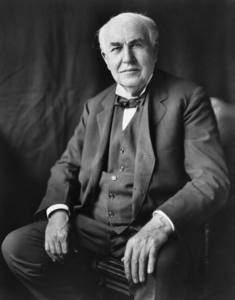 “Interest is the invention of Satan.” ( Edison, Thomas A. Interview. The New York Times, 6 Dec. 1921.)
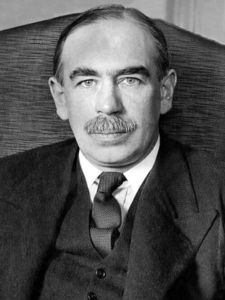 “For at least another hundred years we must pretend to ourselves and to everyone that fair is foul and foul is fair; for foul is useful and fair is not. Avarice and usury and precaution must be our gods for a little longer still.” (Keynes, John Maynard. “Economic Possibilities for our Grandchildren.” Essays in Persuasion, Macmillan, 1931, p. 372.)
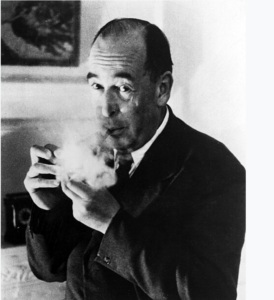 “There is one bit of advice given to us by the ancient heathen Greeks, and by the Jews in the Old Testament, and by the great Christian teachers of the Middle Ages, which the modern economic system has completely disobeyed. All these people told us not to lend money at interest; and lending money at interest—what we call investment—is the basis of our whole system. Now it may not absolutely follow that we are wrong.” ( C S Lewis, Mere Christianity, 1952)
What this is about?
We believe;
- Every household should own or have control of its own home.
- That this is good for society as a whole, as well as individuals and households.
- Widely distributed home ownership is possible and it can help to be achieved by people of faith and good will.
- The common good ought to be the end of any corporation’s activities and that it is possible to “do well by doing good”
We have developed a model to provide good quality housing at a cheaper than market price.
However, it requires investors with a particular mind-set who are prepared to be patient and concerned to meet human need for shelter.
This is a call for such investors
Pleroma Property Investments Pty Ltd is a distinctive, commercial and social enterprise hybrid organisation. We are driven to “do very well by doing good”. To that end we have acquisition a number of properties which allow development according to the principles enshrined in our development philosophy.
In acquiring these properties, we had no alternative at the time, other than to use debt finance provided by “private credit” providers.
The reasons for this are deep rooted. Commercial banks, responding to changing regulation vacated this space, creating a financial vacuum which was quickly filled by “private credit” operators.
This movement of unregulated, ethically questionable players into the residential housing development market has had very detrimental effects, the full import of which are now emerging.
Relationships with these providers have proven to be a set-back to the company’s vision and purpose, but they have not proven destructive. “First-hand” experience has afforded us, the intellectual tools and weapons with which to fight back. We now work to expose morally reprehensible and socially destructive practices and pro-actively formulate a better way forward.
Recent events have caught the attention of the regulatory authorities. This is a good thing, but of itself, it will not solve the housing crisis we currently experience.
To make a lasting change, sometimes the change has to be driven from the bottom up!
Our model is based on minimising the use of interest bearing debt, if not doing away with it altogether.
The reasons for this are both philosophical and commercial. And they are every sound.
Philosophical considerations:
The philosophical reasons are really very simple.
As the captions indicate, debt funding of projects and the payment of interest (usury) is one of the major cause of the current housing crisis. Usury has been known to be an evil practice since time immemorial. Left unhindered and unregulated, it has proven destructive to societies in all places and at all times. It is also a root cause of personal, civil distress and international distress. It is no more than a mechanism invented by powerful interests to ensure the transfer of wealth from the many to the very few.
This is not just a philosophical issue. It is a practical issue for economists, politician and legislators. As a root cause of asset inflation, it is putting basic necessities (like shelter) out of the reach of the vast mass of people. This is causing increasingly violent reaction even now (see here How Europe’s housing crisis is fuelling a new movement | World news | The Guardian).
As an example of the international damage usury can do, the early twentieth century economist, John Maynard Keynes understood that interest on reparations demanded of the defeated powers and war time loans made to allied nations, at the end of WWI, would not end well. He warned in 1919, that all those nations would eventually default (which all did by 1933 – Finland excepted). Worse still: it would contribute directly to German default, German re-armament and ultimately to the foretaste of a coming Hell, which was the Second World War.
General George Marshall learnt that lesson well. After the Second World War ran its course, rather than demand reparations or even lend money to the defeated powers and allies, they were granted interest free aid to rebuild. The results were profound. Germany, Italy and Japan re-entered the society of civilised nations, rebuilt their economies and the Western World enjoyed a long and prosperous period of relative peace. A devout Episcopalian Christian, he understood only too well, it was far better to forgive debtors and enemies, seek their good and “…bear one another’s burdens, and so fulfil the law of Christ…”.
How true is the saying; that those who don’t learn from history, are doomed to repeat it!
Socio-economic and Commercial Considerations:
The practice of usury has very dire economic and commercial consequences. As a mechanism designed to transfer wealth from the many to the few it is a direct cause of wealth concentration, especially of assets required to meet fundamental human need such as shelter. It has created very deep social divisions, which carry inherent risks of violent civil unrest.
There is absolutely nothing new in this! From the ancient Greeks and Romans:
“The rulers, being aware that their power rests upon their wealth, refuse to curtail by law the extravagance of the spendthrift youth because they gain by their ruin; they take interest from them and buy up their estates and thus increase their own wealth and importance….and recover the parent sum many times over multiplied into a family of children: and so they make drone and pauper to abound in the State” [Plato. The Republic. (VIII, 555)]
“The cancer of usury is an old venomous sore and the chiefest head and cause of rebellions in countries.” [Tacitus. The Annals (BK ) ~106 – 109 AD, accessed through the Gutenburg Project]
Through the Middle Ages and into the modern era:
“Usury overthrows trade, decays merchandise, undoes tillage, destroys craftsmen, defaces chivalries, beats down nobility, brings dearth and famine, and causes destruction and confusion.” [Thomas Wilson in “A Discourse Upon Usurye.” 1569]
And even in our own times!
“A fiat monetary system allows power and influence to fall into the hands of those who control the creation of new money, and to those who get to use the money or credit early in its circulation. The insidious and eventual cost falls on unidentified victims who are usually oblivious to the cause of their plight. This system of legalized plunder (though not constitutional) allows one group to benefit at the expense of another. An actual transfer of wealth goes from the poor and the middle class to those in privileged financial positions.” [Congressman Ron Paul (R-TX), “Paper Money and Tyranny” 2003]
“All that we had borrowed up to 1985 was around $5 billion, and we have paid about $16 billion; yet we are still being told that we owe about $28 billion. That $28 billion came about because of the injustice in the foreign creditors’ interest rates. If you ask me what is the worst thing in the world, I will say it is compound interest.” [President, Olesegun Obasanjo of Nigeria, 2000, quoted by Rodney Shakespeare, The Modern Universal Paradigm 2007, P63-P64.]
“In the 1930s, faced with problems of sovereign and other debt similar to those of today, the pretence that debts could be repaid was maintained for far too long.” [Mervyn King, Governor of the Bank of England. A speech at The Millennium Centre, Cardiff 23 October 2012. http://www.bankofengland.co.uk/publications/Documents/speeches/2012/speech613.pdf]
The collapse of the Bathla Group in NSW, has caused many related commercial operations to also collapse, diminished competition in the construction sector, caused building commencements to stall, and driven up the cost of construction. It’s a very vicious, non-virtuous downward spiral. The untrammelled greed of a few, causes distress for the many!
The Effects of Usury Based Investment on the Housing Industry in Australia
Without large scale public housing, most housing in Australia has been delivered by the private sector and has been funded, in the main, by debt capital.
Consequently, the main driver of housing supply has not been the need or “demand” for shelter. It has been the lenders “demand” for a return on investment. The demand for financial return imposes a structural limit on housing supply, as anything greater than this structural limit will threaten the demanded return. That structural limit can be quantified. Actual new dwelling supply has been within a measurable band between ~150,000 new dwellings to ~190,000 new dwelling per annum.
Except for an large “blip” in supply between 2013 – 2018 (the period of the East Asian Money Flood) supply has been constrained within this narrow band, irrespective of population growth, or GDP growth. This band has been consistently the same over a 45-50 year period!
This band is not significantly correlated to population growth and underlying demand for shelter.
Australian housing supply constraints have ensured that long term price inflation is the attractor which underpins “investment” in the property market. Local and foreign capital chases returns through “capital gains”, rather than through research and development, innovation, technology and new product development.
Debt funding for housing development has more recently, opened up opportunities for the “shadow banking” (and ethically challenged) world of “private credit”. This industry has grown very rapidly, from relatively humble beginnings and is now estimated to be worth around $250B pa with growth rates around 10% – 15% pa (see graph 1. below). Though still a relatively small component of overall lending in Australia, it is very heavily weighted to development finance.
This heavy dependence of housing delivery on private credit, has exposed housing supply to very high structural risks which can be summarised in three key points;
- The interest costs to a project are excessive and add significantly to the required price realisations of the final product. Many projects in the market segments where need is greatest, are therefore financially unviable. Direct inflation effects through the use of “private credit” can be between 13% – 15% pa over the life of a development project.
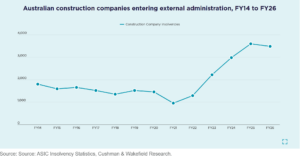
- Debt servicing requirements are extremely unrealistic. Detrimental impacts on operational cash flow for builders and developers lead to insolvency very quickly and ultimately to collapse and bankruptcy. This we are witnessing even now (see graph 2. below).
- The social effects are very damaging and magnified throughout the economy. Undeniably, the cost of “private credit” has been a direct contributor to large scale building insolvencies, and their broader socio-economic effects
Graph 1. Private Credit Growth In Australia
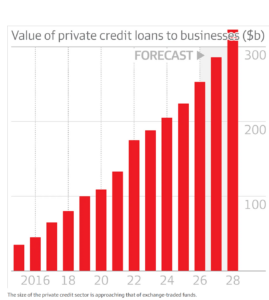
(AFR, Private credit, its role in Australian financial markets and whether it will bring about the next global financial crisis accessed, October 2026)
The graph above should be compared to the graph below, which is concerned with insolvencies in the construction industry.
Graph 2. Australian Construction Company Insolvencies
(Cushman and Wakefield, Private credit stress: why Australian BTR is insulated, but not immune | AU | Cushman & Wakefield accessed October, 2026)
The correlation between the growth of “private credit” with the rate of building company failure, is unmistakeable.
Many builders, especially smaller builders have debt finance, from both “private credit” providers and also from retail banks. Many of these smaller builders and sub-contractors go under, when debt dependent developers, go under and cannot meet payment obligations to their builders and sub-contractors. The ripple effect throughout the economy has a negative impact.
The real life laboratory is open for all to see the above noted principles at work!
What is the solution?
The problem is more than obvious. The solution is also obvious.
It requires the excision of the “cancerous” component of modern finance; the practice of usury. Equity based, ethical investment where the investors, whether they are public or private invest to gain rewards which are both social and monetary, but which are not dependent on the practice of usury, is the solution.
Public Investment
Public investment in housing through government agencies is very much needed, especially to meet the needs of those who have been locked out of home ownership by the current, financialised housing system. The only hindrance to public investment in housing is the will of governments.
Our main concern, however, is a different model of private investment.
Private Investment
Private investment which is equity based, can achieve good social outcomes and still provide a good return for the investors.
The model is very simple and based on our philosophy of higher quality living and environmental repair. The main principle is the following.
Investors become “tenants-in-common” in all our properties.
This is not a Managed Investment Scheme, run by others for a fee. This is about like-minded, concerned people pooling resources as they are able, to achieve a good social and personal outcome.
The main benefits of owning property as “tenants-in-common” are as follows;
- Two or more people co-own a property in defined proportions.
- There is no required limit to the number of owners.
- Tenants in common allow individuals to hold their own distinct, defined shares in a property.
- Ownership can be equal or unequal. For example, one person may own 99% of the shares, with the other owning 1%. The precise way that you choose to split the shares is up to you and the other parties.
- Tenants in Common can deal with their proportion/share as they wish.
- There are no rights of survivorship in such arrangements, meaning that the death of an owner does not impact other owners’ proportional ownership.
- Each tenant-in-common can freely sell or bequeath their share at will.
- This is a good way for investors who do not have large resources to acquire direct ownership interests in property and reap the benefits of any rental stream, capital gains or future development uplift for suitable properties.
- Owners are recorded on title so that their ownership is secure. This is not a unit trust or a shareholding in a company.
What are the downsides?
The main downside is that the number of owners can become quite unwieldy and that unforeseen events may cause costly damage to property. Neither of these is detrimental to the concept. There are ways of managing these ownership risks which are well within the knowledge of most property owners.
To that end, it is proposed;
- That the owners appoint a “post person” to ensure that communication between all owners is distributed regularly.
- The property is managed by a local agent to lease as necessary, collect rents, instruct and approve minor maintenance and repairs
- The property be properly insured
- Costs such as rates, land tax (if applicable) and agents managements costs are to be paid out of any rental income streams
As Pleroma Property Investments Pty Ltd is offering direct ownership of properties it currently controls, we would like that all prospective owners take a longer term view and that they come on board with the desire to see our properties developed according to our development philosophy.
A simple owner’s agreement is proposed. This will be forwarded to interested parties.
Our main goal is very simple – get rid of all borrowings if we can, or at the very least, limit them to the greatest degree possible.
Is this a good way to invest?
The question is a good one. A high level comparison of investment strategies is included below.
Firstly, addressing returns:-
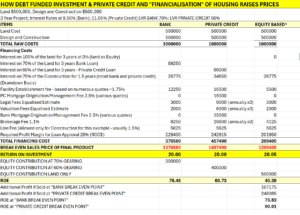
Returns on investment (funds employed) are better than debt funded investment, though the returns on equity are worse in the short term, but improve over the longer term and in due course are superior to debt funded returns on equity (see table 1. below).
Secondly, addressing risks:-
Risks are far lower than with debt funded property acquisition and development.
- If fully owned, no creditor can foreclose. Owners can simply choose to hold or pursue further development at their leisure without the threat of lenders calling in their loans.
- Even if mostly owned, a sufficiently low loan to value ratio will ensure that time based, Market pressures or minimised or even avoided altogether.
- The full equity model (or as close as possible) means that much less of income from the property and personal income is “bled out” in often unpredictable interest rate movements and the free cash left to owners, can be used for additional or alternative investments
Debt funded investment strategies hold promise of much higher short term returns on equity, but with substantially greater attendant risks. Indeed, leverage of any form will only magnify losses in a downturn (which are regular components of business cycles). Equity based investment, on the other hand, does not hold out promise of very high, short term returns but as equity approaches more closely “risk free” limits, does promise far better returns over the longer term.
Thirdly, addressing the bottom line:-
Debt funded investment is driven by the need to make a rapid return so that the bleed out of interest rates is limited and the risk of foreclosure is mitigated as far as possible.
The race to maximise profit quickly, at the expense of all other considerations has led to very poor, even damaging social and environmental outcomes.
Equity investment on the other hand, without the pressure of meeting lenders expectations, can begin to change housing for the better. It just requires a start; however small it is and however ludicrous it may seem.
“….Truly I tell you, if you have faith as small as a mustard seed, you can say to this mountain, ‘Move from here to there,’ and it will move. Nothing will be impossible for you.” (Matthew 17:20)
Crunching the numbers
What follows below is a high level comparison of the effects of debt and equity investments in housing.
Assumptions:
Project Costs
Land Value $500,000; Total Development Costs per Dwelling $500,000
The figures are illustrative only, to test effects of debt on a project and compare it with the effects of greater proportions of equity.
Interest Rates
Retail bank rates for property development investment (if available) and construction: 8.5% average (see here Current Business Loan Interest Rates in Australia | Sydney Melbourne Brisbane Perth)
Private Credit rates 11% average (see here Private Loan Interest Rates Australia 2026 | Guide)
Loan to Value Ratio’s
Retail bank LVR’s: 70% average
Private Credit LVR’s: 60% average
Retail bank loan for full project period
Private Credit loan rolled over annually.
It is assumed that the time periods for a standard project are between 3 years and 5 years and effects are examined at these two time limits.
Table 1 – Effects of Debt Funding on House Prices over 3 Year Development Period
Summary Notes
The following summary notes highlight the main findings.
- Assuming feasible projects, the project funded in the main by equity is the most feasible and has the least attendant risk.
- Over a 3 year project period, all things being equal and with no “shocks”, return on equity (ROE) appears higher a project debt funded by a retail bank.
- For retail bank funded projects, in Y3 the sales price needs to be $167,175 (~13.8%+) higher than the same project funded by equity. Any economic/market “shock” will more easily shift the debt funded project from being feasible, to being unfeasible.
- The private equity credit funded project needs an additional $248,085 (~20.5%+) higher per dwelling sales price to achieve the higher ROE. Shocks will heighten risk very much more.
- Unfeasible debt based projects, still attract substantial holding costs until divestment.
- Exposure to the risk of heavily discounted “fire sales” prices is heightened.
- The much lower hurdle for equity based projects allow them room to increase ROI, while simultaneously undercutting “like-for-like” debt funded projects.
- Equity based projects have room to equal or better ROE for debt funded projects, with little change to project risk profiles.
We now examine the same base project over a 5 year period.
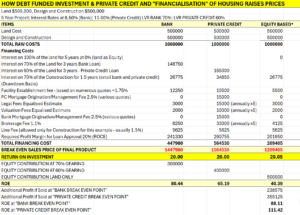
Table 2 – Effects of Debt Funding on House Prices over 5 Year Development Period
Summary Notes
In general, the same notes apply in this instance as in the shorter time frame instance. All things being equal, the required sales prices to make debt funded projects feasible, begin to diverge markedly and negatively from equity funded projects, as does the potential ROE.
At Y5, difference in required sales prices compared to equity funded projects are as follows;
Retail bank debt funded projects – ~+19.7% (cp +13.8%, Y3; an increase of 42.75% over 2 years)
Private Credit debt funded projects – ~+ 29.4% (cp +20.5%, Y3; an increase of 43.41% over 2 years)
At 8 years and at 10 years the emerging pattern was unequivocal. Debt funded projects require highly inflated housing asset to remain feasible, while at the same time, returns as measured by both ROI and ROE are severely diminished, relative to equity based investment.
The divergence in ROE was marked. At required sales prices for debt funded projects, ROE on equity funded projects began accelerating higher than debt funded projects. The corollary of this, is that equity funded projects, over time, can be sold at heavily discounted prices and still match ROE on debt funded projects.
Key Takeaways
- Equity based projects have greater and far less risky returns over time and are not significantly inflationary due to funding type.
- Debt based projects offer the prospect of larger but far riskier and more volatile returns in the short term only.
- Debt based projects are significantly inflationary and become unfeasible quite quickly.
- Equity based projects enable a higher quality end-product for a lower price. The money saved on financing costs can be put towards a higher quality product, which can attract a premium while concurrently contributing positively to the environment and living quality.
None of the above is really new. The numbers simply confirm what wise people have always known.
The Call
Pleroma Property Investments Pty Ltd currently has control over a number of properties with very good uplift potential.
We also have access to properties in regional NSW and further afield (nationally) which afford opportunities to co-own and co-develop with institutional land holders.
We have learnt the hard way, that the financial system is flawed and designed to make the few very wealthy and reduce the many to subsistence levels within their nations and cultures.
As we see worldwide, governments in the main have not been able to provide solutions.
The alternative to the “top-down” approach is to start at the bottom and work up! To do that we need special people who understand that “Wealth gained hastily will dwindle, but whoever gathers little by little will increase it”.
Slow money is money that lasts and does good at the same time; get rich quick schemes bring ruin
Our vision remains to improve living environments while we work at repairing the environment, one site at a time.
This will not be for everyone and we only want like-minded people. If you are interested in finding out more about ownership opportunities, please use our contact form to reach out to us.