
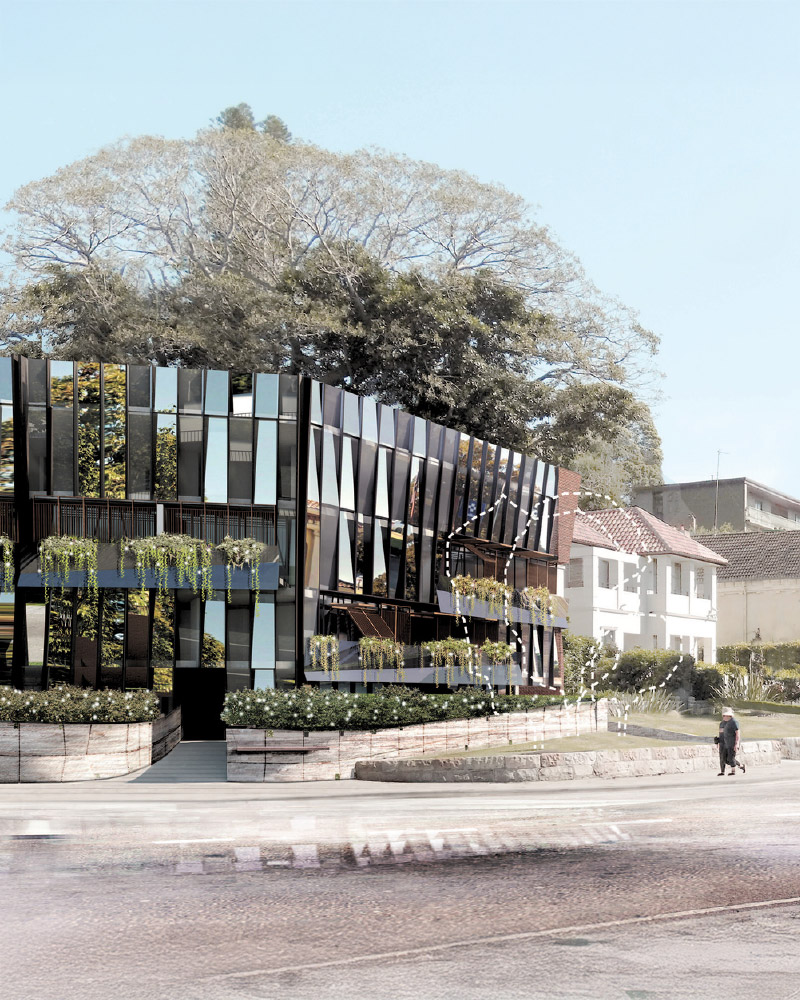
The relationship between property developers, architects and designers, planners and planning legislators is often portrayed and thought of as a kind of “war”. The press and much of academia reinforce this view in the public mind.
As competing stakeholders in what should be a process for the benefit of all, the property developer is the modern “Goldstein”, the object of hate and scorn, worthy of a daily one-minute hate fest! Along with the shadowy Mephistophelian figures who egg him on, the Ebenezer Scrooges and Shylocks of the banking industry, the property developer is seen as the thin edge of the wedge of everything that is destructive environmentally, socially and ecologically.
Architects and other design professionals are seen as reasonably good guys. Mostly, they are licensed professionals, ensuring that in the common mind, they have some semblance of worthy social standing. Their relationship with developers is a remarkably interesting one to say the least. An old saying about occasionally biting the hand that feeds you comes to mind. Nevertheless, architects in particular, have one of the most important roles to play in contributing to human flourishing.
Planners, see themselves as the quintessential “good guys” because they participate in both determining and enforcing the rules which developers and designers must play by. Fortunately, for them, in the public mind, they are often accepted as the good guys who put a bit and bridle on the excesses of the other players.
The purpose for writing this short piece is not to reinforce the common perceptions outlined above, but to hint at something far better – a collaboration between all for a higher good than just making money or enhancing reputations. It can be done.
We all think we know what developers do – rape and pillage the environment in order to make “filthy lucre.” Like their backers, the usurers, they are presumed to worship at the altar of Mammon. Enough said!
But what about architects?
Architects (traditionally) were concerned with the form the built environment takes as an object of both utility and art. Firstly, with regard to utility, the building as an object ought to meet the needs and wants of a number of key stakeholders, the end-users being a major stakeholder. In this regard, the building ought to be a product of the pursuit of excellence in craftsmanship because this means the building will function according to need and design, without constant need for time-consuming, uneconomical, and wasteful repair. Efficient use of resources throughout the entire life of the built form has a definable social value.
Secondly, the building ought to display, artistic excellence, both in conception and execution. This enriches the wholeness of the environment in which the building sits and by extension, the wholeness of the community. I could put it this way: if the internal functioning of the building pertains to the occupants, the external appearance of the building pertains not only to the occupants or owners but also to the community. The community is negatively impacted by low-quality design and disregard of any sense of duty to enrich the lives of others through the practice of an art. The architect was traditionally charged with making an object which was at once, in the words of the first-century Roman architect and engineer, Vitruvius Pollio “commodious, firm and delightful”; or to quote Keats would say, “a thing of beauty and a joy forever.”
Let me turn to planners and planning.
We mostly have a good grip on what they do. They help develop the rules and are also instrumental in enforcing the rules. That is simple enough. However, I will deal with one issue only here: do planning rules guarantee a good outcome? My answer, for what it’s worth is that sometimes they do, many times they don’t. I’ll explain why I think this is the case.
Planning legislation and building compliance legislation are generally reactionary. The guiding principles are often determined by the judiciary when an unforeseen issue or complex problem arises in the planning approval process. Sometimes, the planning legislation itself is purely reactionary, as for example, Australian responses to the Grenfell Tower disaster in the United Kingdom attest.
Consequently, legislated planning requirements can be in certain circumstances,
- a brake on economic growth as the costs of compliance tend to affect investment decisions—high cost of compliance tends to diminish investment; low cost of compliance tends to attract investment and,
- a brake on innovation, design excellence, artistic experimentation and environmental repair.
The above are negative outcomes of legislation but mention must also be made of positive outcomes. In certain circumstances good legislation can also be a necessary brake on naked self-interest, especially when the self-interest of project proponents can be demonstrated to be deleterious to community interests. There is another positive outcome possible with good legislation, and that is, previously poorly used land can be rezoned for better uses, and also positively increase equity in overall land use.
In the Australian experience, legislated requirements tend to set a minimum standard for development. The developer and his or her architect must aim for that standard, if the developer wishes to minimise planning risk and have a project with the strongest likelihood of approval. This does not mean that the proposed project is a “good” project i.e., that it solves profoundly important artistic, social, ecological, and environmental problems. In fact, it means nothing more than it complies with the current planning rules and regulations, which is not the same thing as any assertion of “goodness” or “badness” in design or other appropriate outcome. Neither can it be claimed from a purely economic point of view, that aiming for the lowest common denominator, expressed in planning rules and regulations, will provide a reasonable return on investment.
At best, the rule–compliance nexus enforces an adequate standard of development but does not ipso facto require excellence; at worst, it permits development of extremely low quality in construction, affordability, and sustainability. And this type of development, unfortunately predominates ubiquitously on the Australian housing landscape.
What saddens me is that this “adversarial” playing field has arisen because all the players up to now, have been concerned with, or should I say, even consumed by one thing only: “the-what-we-live-in”! What is required is a mind-shift to “how-we-live-in” the environment and our communities whether they are urban, suburban, or non-urban. This mind set change requires us to see the players in the housing/shelter field as collaborators who are guided by higher aims that just compliance to temporary rules and regulations. The diagram below, serves to remind us of the size and complexity of the property development field of practice
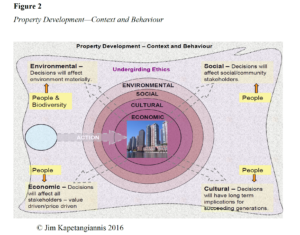
Property development is not just an economic activity; it’s a social, environmental, economic and cultural activity, which must not be only for the ultimate benefit of financiers or an ever relatively diminishing group of wealthy people. The land and its potential uses will remain even after the few who see it as their personal possession are long gone and have turned to dust. We really do need to see ourselves as stewards rather than owners.
At Pleroma Property Investments we have deliberately set ourselves a different course. Informed by our spiritual and ethical frameworks, we see the changing of land uses (property development) as a practice that can aim for the common good. We seek to work on our own projects to illustrate this, work with institutional land holders who share our values and lobby those in authority to work towards and legislate for beneficial change.
We swim against the tide – deliberately so! If you would like to join us in any capacity, investor, co-worker, co-lobbyist, please get in touch. We want to build a movement for change.