
SOLUTIONS TO THE HOUSING CRISIS EXIST!
Old solutions applied anew
I have no doubt that my description of the current housing crisis below, will cause some consternation. To those who are convinced that the housing crisis is determined by what one pundit called, “the iron clad laws” of economics, my apologies to those people in advance.
The high end data
The current housing crisis is not one that has been caused by housing supply falling short. To my point, see the summary in the table below of most recent data published by national statistics bureaus of the five Anglosphere countries.
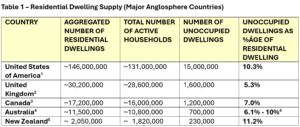
Unequivocally, there is more than enough housing for all the households in these countries and then some. The conclusion; the root cause of the current housing crisis cannot possibly be the issue of insufficient supply. Figures like these are not unique to these countries. Similar figures apply to just about every Western and wealthy East Asian country as well. In fact, the rates of unoccupied dwellings can be as high 20% or even higher in the EU!6
Therefore, I say this as strongly as I possibly can. Those who advocate for more supply as a solution to the current housing crisis are not only wrong in their proposed solution; they are also very dangerous, social, economic and environmental vandals!
What is the point of destroying more of the earth’s resources to create dwellings which will end up mostly in the hands of those who need them the least and which most probably, will just remain empty? I’m sure that this will be an even more acute problem very soon. Most of the wealthy world has reached peak population and is in serious population decline. But I digress.
This begs the question; if there is more than enough housing for all households and many more, what then is the “crisis” and why so much anxiety about it?
Understanding the “Crisis” – the symptoms.
Here’s where I run the risk of giving offense, especially to many professional economists, certainly to bankers, money lenders, their property acolytes and the ubiquitous wealth creation spruikers. That there is a crisis is undeniable. However, it is obviously not a crisis of being housed. It is what I will call for lack of better words, a psychological crisis of personhood, brought about, not by lack of supply, but by restraint in access, unsatisfactory ownership and insecure tenure. In other words, it is a both a physical and mental health crisis of being inadequately housed.
Let me explain.
Taking the Australian example, because tenure of housing is at the mercy of either landlords or mortgagors (rentiers) for at least 70% of all Australian households (possibly more), there is a growing sense of insecurity of tenure which breeds fear and resentment. Housing which does not address the psychological components required for a sense of safety, health and to use a broader term, flourishing, is inadequate housing. Here is just one part of an article expressing an all too common perception of a new reality.7
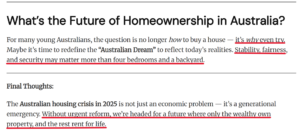
Insecurity of tenure breeds fear, because one’s life can be turned upside down in an instant by some heartless landlord or banker; it breeds resentment because it seems and is in fact, grossly unjust. That one should be a modern day “wage slave”, enriching others for most of one’s working life is hard to bear. It means that much enjoyment of life, short, nasty and brutish as it may be according to some deranged philosophers, has to be forgone, simply to keep a roof over one’s head.
What I have described above, are the symptoms of an underlying acute disease, a kind of social cancer.
The underlying root cause
So then, what is the root cause?
I have only one answer; it is the current financial system which concentrates ownership of assets, residential property included.
Concentrated ownership (both private and state) takes power away from the great mass of householders for whom dignified and secure shelter is a basic human need. In the case of concentration of ownership in private hands, it is the mechanisms of modern money supply, which bring about this concentration. The key mechanisms whereby this is done, is by the creation of debt to be repaid with interest.
The debt creation secures the power of the lender over the asset of the borrower. The debt obligation enables the asset to be disposed of by the borrower to settle the debt on terms most beneficial to the lender. This is mostly done without any further reference to the human needs of the borrower.
The interest obligation secures the power of the lender over the person of the borrower. For lack of a better word, it “indentures” the person of the borrower to the lender, until the entire debt, with interest is paid off.
Supporters of this system claim that lending provides a social good by giving many access to capital they would not otherwise have access to. But that is not really the issue (and to be honest, it’s not really true either). A social good can only be judged by outcomes and the outcomes of the current financial system are not necessarily conducive to the common good. It is a system designed for and very conducive to, a wholesale transfer of wealth from the many to the few!
Consider the following image. I’ve highlighted the important text.

Cotality, 2026
In a few short months, the Reserve Bank of Australia has raised the cash rate three times (0.75%) and as highlighted in the image, those rises have caused the cost of a very standard mortgage, for a rather standard house to increase by over $17,000 per annum. Does anyone stop to think that this means that the median household disposable income of $106,000, has dropped by a massive 16% in less than half a year? And where does this money go? It does not go the government to be spent for the common good. It goes directly to those who lend money!
Putting aside the economic jargon which dehumanises the reality of what is occuring here, an additional 16% of whatever “wealth” the median household generated, is now being transferred to the lender of capital. The household now has much less to spend on its own needs. There is no humane sense of justice in this state of affars. It is not a transaction between equals!
Those with wealth and power (the lenders) stand in a dominant position in the transaction and are driven by greed. The borrower is in the weaker position, driven by need.
The quid pro quo of the transaction, is literally, to be beholden to the lender for as long as it takes to pay the principal back with many times the principal, in interest. This is why I wrote above, it is a system deliberately designed to transfer both wealth and power to the few.
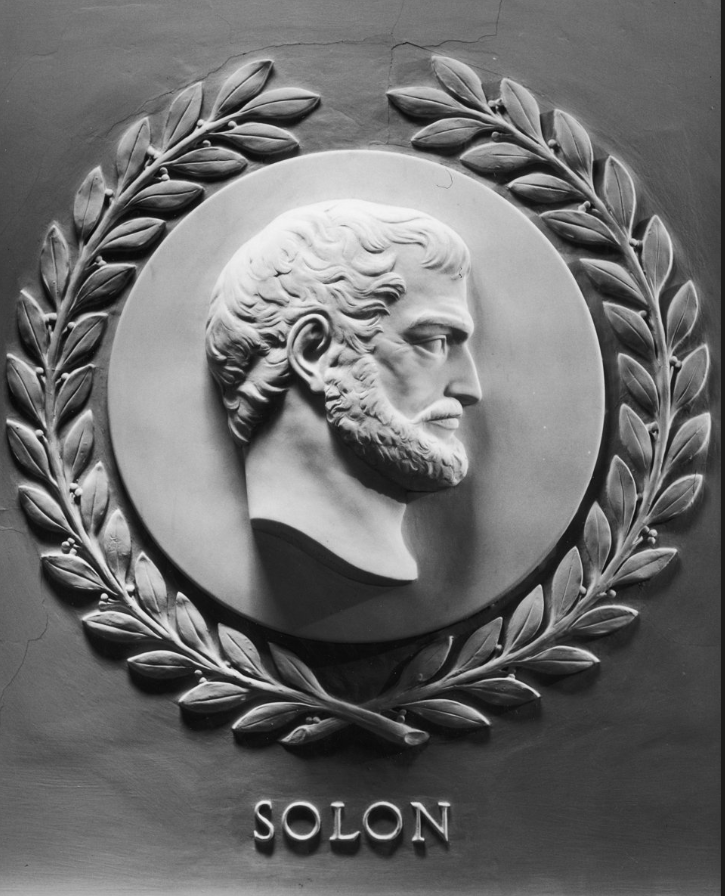
Solon’s reforms – the old made new!
Around 2700 years ago, in youthful Athens, a great legislator was faced with very much the same issues as we are faced with today. His predecessor, a not so gentle man by the name of Draco, had let things get so out of hand, that the wealthy elite, by lending money to the farmers and artisans had driven the state to the brink of civil war. The farmers in particular, who were subject to the vagaries of nature, were often in need of capital to purchase seed and no doubt, support themselves with daily necessities while they waited for their harvest.
Unfortunately, farming being what it is, was a high risk venture then, no doubt more so than it is now, and crops often failed. Under Draco’s constitution, the lenders were entitled to respossesion of the property of the farmers and to the enslavement (or much worse) of their “person”. Within a few bad seasons, just about all the land was in the hands of the very wealthy and with no-one to work it because the farmers were either slaves or dead….
In the end, the system of free rein to the wealthy under Draco’s constitution, ruined life for rich and poor alike. It was for this reason, every class called upon Solon, quite literally, with one voice, to rescue the state and to keep Athens from descending into murderous civil war. He succeeded in this with some bitter but very good medicine and there is much we can learn from his reforms.
Solon’s economic reforms included three basic elements (among a number of worthwhile others);
- Forgiveness of Debts, especially for those who were critical to the proper functioning of the state, farmers and craftsmen
- The release of the person from personal liabilities, thus ensuring that they remained free to pursue their vocations for the benefit of all
- Legally set limits on property ownership so that property essential to the welfare of all as individuals and in common could not be concentrated in the hands of the few and remain unproductive. Just think of all the houses which remain empty in our own time!
Solon’s reforms were so successful in his time, that he is remembered millennia later as one of the Seven Sages of ancient Greece, and particularly as the one who set Athens on the path to democracy. Aristotle wrote of him in his work, “The Athenian Constitution” (Sir F.G. Kenyon’s translation, 1891);
“Since such, then, was the organization of the constitution, and the many were in slavery to the few, the people rose against the upper class. The strife was keen, and for a long time the two parties were ranged in hostile camps against one another, till at last, by common consent, they appointed Solon to be mediator and Archon, and committed the whole constitution to his hands.” (Part V)
And in the same work, Aristotle pointed out the root casue of the problem – the love of wealth and the desire to accumulate more than is needful or proper for “flourishing” for all;
“Indeed, he constantly fastens the blame of the conflict on the rich; and accordingly at the beginning of the poem (Solon wrote his thoughts down in poetic form) he says that he fears ‘the love of wealth and an overweening mind’, evidently meaning that it was through these that the quarrel arose.” (Part V)
Anyone who cannot see the rise of populism as the first expression of very deep seated resentment and dissatisfaction with the ruling “elites” who have presided over this state of affairs, really has no sense at all. There is much we can learn from this example of Solon’s reforms. I should say here, his example is but only one amongst many, starting right back when laws were first recorded.
Lending at interest has always led to social crisis, because it is by nature a moral evil. It’s effect is worse when institutionalised and counted as “normal” by those who gain the most out of it. If we really want to solve the “housing crisis”, maybe it is time to look beyond economic technicalities and look, as other have done in times past, at resets for the common good. Moses, who pre-dated Solon by many centuries even saw the need to constitutionally enshrine debt forgiveness in his civil laws!
At Pleroma Property Investments Pty Ltd, we have been giving serious thought to how these issues can be addressed by people of good faith. We hope to have some good news soon of a collaboration with an institutional land holder. In a small way, we will be seeking to address a completely different means of investing which is aimed at the common good. We always welcome those who want to make a difference and believe that the widespread diffusion of all the good gifts of creation, is best for all.
Watch this space.
REFERENCES
- https://www.census.gov/housing/hvs/data/histtabs.html
- https://www.ons.gov.uk/peoplepopulationandcommunity/housing/bulletins/numberofvacantandsecondhomesenglandandwales/census2021
- https://www150.statcan.gc.ca/n1/daily-quotidien/230116/cg-d001-eng.htm
- https://www.abs.gov.au/statistics/people/population. It must be noted that I have used households verses gross housing stock for consistency between jurisdictions. Historically, census night data reveals that on the night of each census to date, around 10%+ of Australia’s housing stock is vacant, representing somewhere around 1,150,000 dwellings on 2025 Qtr 4, estimates.
- Housing in Aotearoa New Zealand | Stats NZ
- https://webfs.oecd.org/Els-com/Affordable_Housing_Database/HM1-1-Housing-stock-and-construction.pdf
- Why the Australian Housing Crisis Is Forcing Young Aussies to Give Up on Homeownership – Australian Business Journal